
Lebanon · Sample Report
Israel – Hezbollah War Report
Post-2024 war through June 2026
Executive Summary
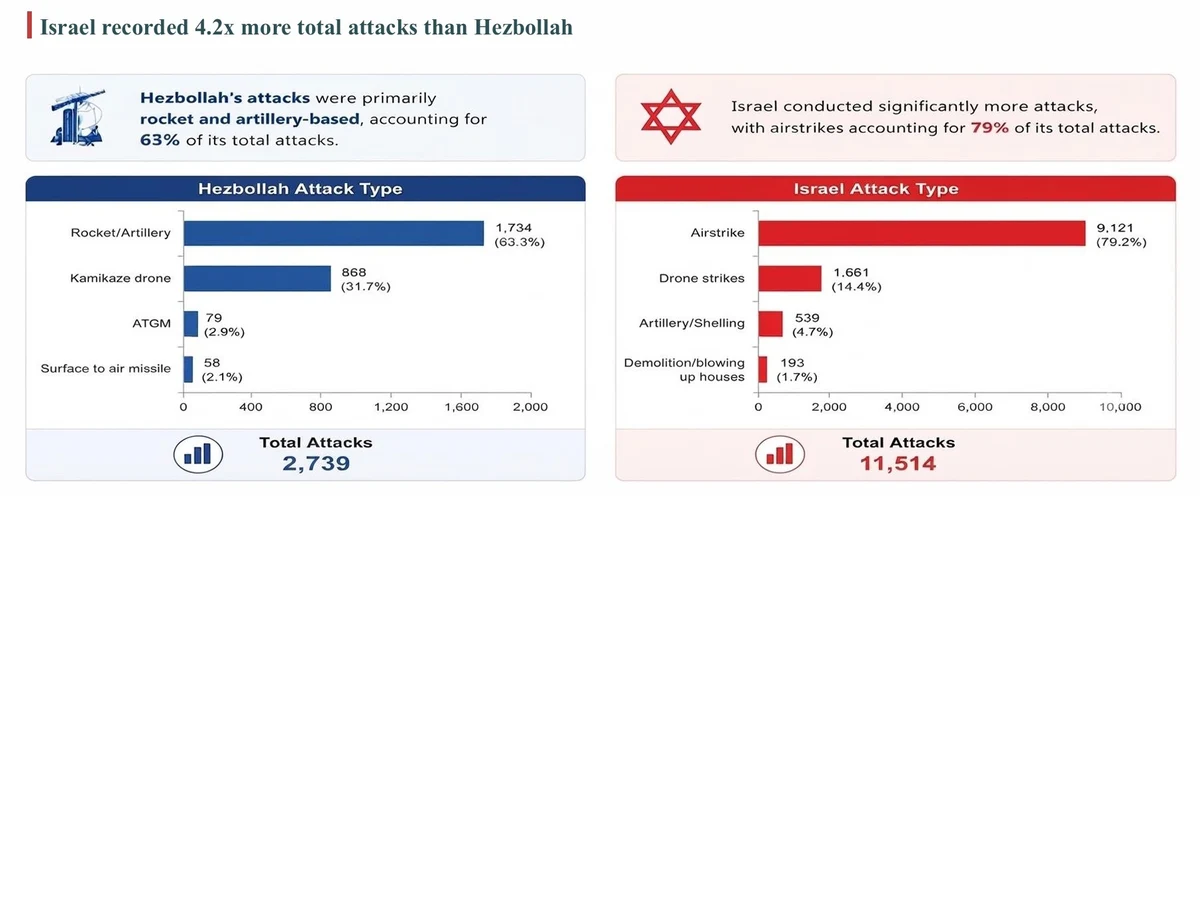
Conflict activity across South Lebanon and adjacent areas continued dynamically following the formal conclusion of the 2024 war. Contrary to public perceptions of a total cessation of hostilities, the conflict environment never fully quieted. Instead, a baseline level of low to medium intensity skirmishes persisted along the Blue Line corridor throughout 2025 and into the first quarter of 2026.
Key Insights
A tactical and geographic shift
Beginning significantly on 2 March 2026, Israeli military operations expanded drastically beyond the traditional southern borders, targeting strategic logistics lines, command elements, and urban centers far deep into Lebanese territory. Despite the first ceasefire taking effect on 17 April, operations expanded into the Bekaa and Baalbek-Hermel by 27 April and Beirut on 6 and 9 May.
Operational dynamics and escalation patterns
March was characterized by intensified cross-border kinetic activity, primarily within the South Lebanon and Nabatieh governorates. By mid-April a clear geographic diversification occurred, with regular deep-theatre strikes hitting the Bekaa and Baalbek-Hermel governorates. The escalation peaked sharply in May 2026.
A decline in tempo
Toward the very end of June 2026, field analysis indicated a visible bilateral decline in operational tempo. Israeli kinetic activity gradually decelerated in frequency, while Hezbollah activity originating from Lebanon toward northern Israel dropped significantly, approaching negligible levels by late June.
Fadi Georgio · Research & Development Manager
Join our Analytical Reporting Newsletter
Leave your details and our team will send you the complete report, along with future editions as they are published.
Looking for something else? Browse all sample reports